Click Images For Larger View

VF-22S Fighter mode

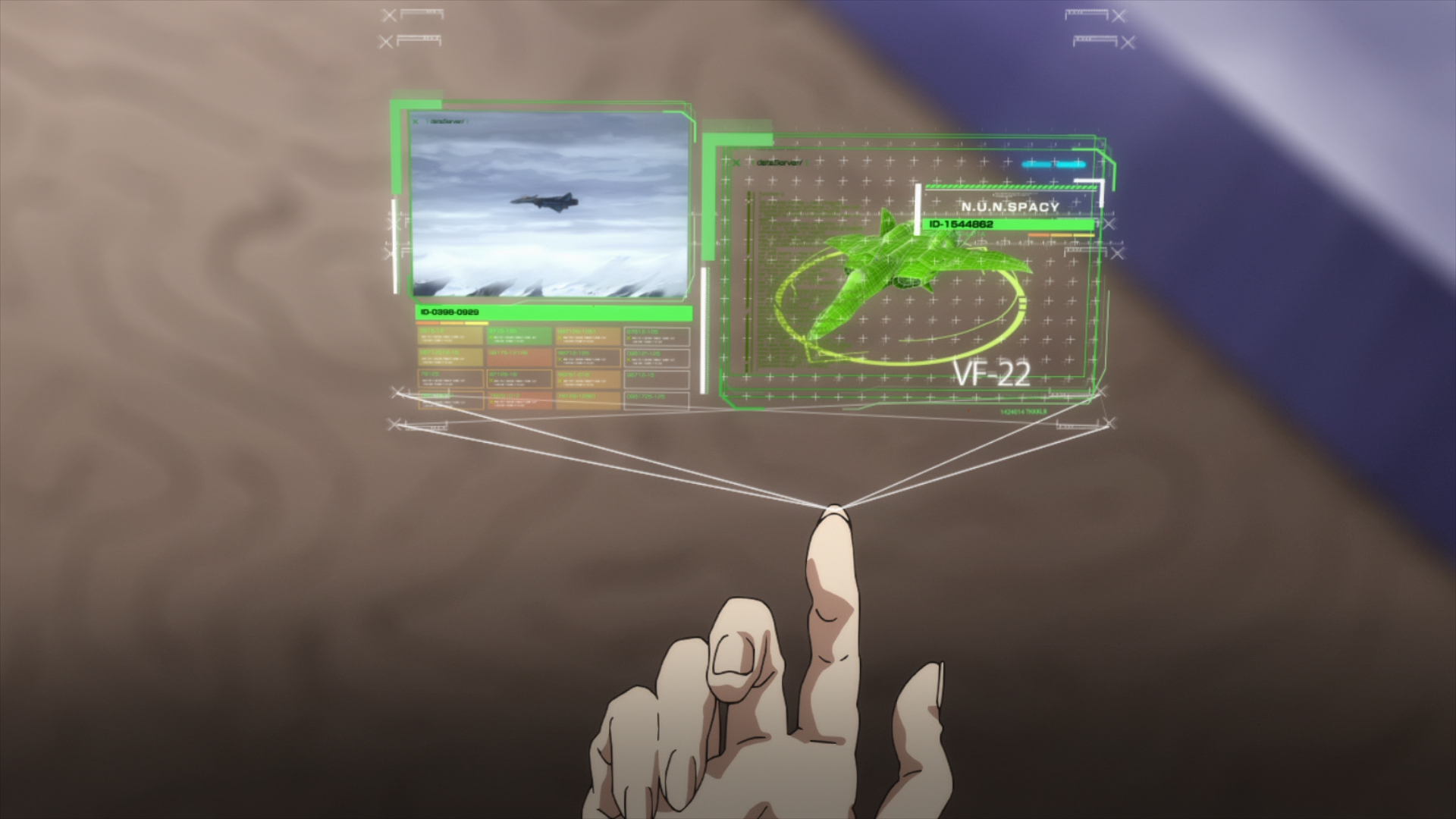
VF-22S Fighter shown in flight recorder

VF-22S Fighter kept on Windermere

Last flight of Immelmann's VF-22S on Windermere
|
General Galaxy VF-22S Sturmvogel II
Equipment Type: UNS special operations variable fighter
Unofficial codename: Falcon 2
Government: U.N. Spacy
Manufacturer: General Galaxy
Introduction: 2046
Operational Deployment: 2046
Accommodation: pilot only in g-endurance zero/zero ejection seat (pilot wears Tactical Life Support System with upper and lower g-suits and pressure breathing); cockpit completely shielded; pressurized cockpit (external view through overhead spherical canopy, one forward panel and two side panels in cockpit hatch)
Dimensions:
Battroid Mode: unknown, estimated height 15.5 meters
Fighter Mode: wingspan 15.36; height 4.04 meters; length 19.62 meters
GERWALK Mode: wingspan 15.36 meters
Mass: empty 9.55 metric tons; VF-22S variant, 9.34 metric tons
Structure: SWAG energy conversion armor, stealth composition
Power Plant: two Shinnakasu Industry/P&W/Roice FF-2450B thermonuclear engines
Propulsion: 41,200 kg [x g] x 2 class (maximum instantaneous thrust in atmosphere; 65,200 kg [x g] x 2 class in space) (in space 639.61 kN x 2); engines utilize air as coolant/propellant in atmosphere, but problems with cooling efficiency (attributed to exceeding output and melting the core) limit maximum thrust to 40% to 60% of thrust in space; 2 x three-dimensional independent convergent/divergent turning exhaust nozzle vanes; 4 x dorsal sub-nozzles above main exhaust nozzles; 2 x banks of pivoting slit nozzles (ventral fuselage) for GERWALK mode VTOL; many x P&W HMM-6J high-maneuverability vernier thrusters.
Thrust-to-weight ratio: (empty) 13.61 (ratio is 8.17 when limited to 60% thrust in atmosphere)
Performance:
Fighter Mode: max cruise speed at 10,000 m Mach 5.06 (VF-22S variant, Mach 5.07); max cruise speed at 30,000+ m Mach 21 (VF-22S variant, Mach 22+); max rate of climb at S/L 61,900 meters/minute
g limit: +60.0/- 45.0
Design Features: 3-mode variable transformation; primarily manually controlled but equipped with brainwave control system for assistance (non-contact connector for brain-wave operation installed in seat); engine block remains on main body in GERWALK and Battroid modes, enabling effcient use of main engine thrust and providing high mobility compared to past VFs; side-stick controller; variable camber wing; enhanced version Quimeliquola Queadluun-Rau special inertia vector control system; two flight configuration modes (cruise and high speed) achieved via varying the cant of wing/tail surfaces; vertical take-off and landing (VTOL); supersonic cruise and maneuvering in region of Mach 5.0+ below the stratosphere; three-dimensional thrust vectoring with three exhaust nozzle flaps on each engine (independent pivot); capable of attaining unassisted orbital velocity over an Earth-class planet; 2 x arm shields/trapezoidal combined variable-cant tail stabilizing surfaces; internal micro-missile launchers (central dorsal section and ventral fuselage); internalized gun pod racks; fighter-scale pin-point barrier system (PPB); active stealth system; 1 x special equipment hard point station for optional 1 x Shinnakasu Industry/OTEC FBF-1000A external prototype fighter fold booster (not certified for performing folds beyond a one-way limit of 20 light years)
- Armament -
Guns:
1 x OTEC XX-2C high-powered converging beam cannon OR 1 x fixed Erlikon AAB-7 anti-aircraft high-powered converging beam cannon (mounted center dorsal section in Fighter/GERWALK mode, becomes head turret in Battroid mode)
2 x semi-fixed Mauler REB-22 internal converging energy cannons featuring forward/rearward barrels (mounted underneath tail stabilizers in Fighter mode, lower arms in GERWALK/Battroid modes)
2 x Howard BP-14D multipurpose gun pods OR 2 x Hughes/GE GV-17L new standard internal cartridge-less gatling gun pods featuring retractable grip/stealth covers mounted in 8 x hard point weapon stations (mounted left/right internal ventral fuselage in Fighter mode or inside leg storage bay cover panels and/or manipulators in GERWALK/Battroid modes)
1 x fixed fighter-carried Howard PBS-03F pin-point barrier system
2 x arm shields (tail stabilizers in fighter mode, lower arm in GERWALK/Battroid modes); function in concert with barrier system
Bombs & Missiles:
Bifors BMM-24 all-environment high-manueverabilty micro-missile cluster OR 4 x Bifors BML-02S internal all-environment rapid-fire micro-missile launchers featuring 4 x dorsal exit ports and 4 x ventral exit ports (mounted in center dorsal section to sides of engine nacelles and center ventral section to the rear of nacelles)
3 x Stonewell-Royce B-6 standard internal pallets (4 x B-21A internal pallets, exclusive to YF-21 and VF-22S)
Optional Armament:
estimated 2 x exclusive internal pallets for mounting reaction warheads
|
A variant of the VF-22S Sturmvogel II used as a special operations variable fighter in the 2060s by the New United Nations Spacy (N.U.N.S.). During the first Windermerean War of Independence, N.U.N.S. pilot Major Wright Immelmann of the 77th Air Wing was tasked with dropping a dimension eater bomb on the Protoculture Ruins upon the planet Windermere. Instead, Wright lied about turbulence enroute and attempted to fly off course to drop the bomb somewhere far from potential casualties. Suspecting Wright was disobeying orders, the N.U.N.S. command remote launched the dimension eater bomb near the city of Carlisle, wiping out the N.U.N.S. forces stationed there along with scores of civilians. Wright was killed sometime soon after when his VF-22 crashed. Both Wright's body and the VF-22 wreckage were recovered by Windermerean forces. The New United Nations Spacy (N.U.N.S.) kept the operation a secret for years since knowledge of the incident would reveal their non-compliance with treaties prohibiting the use and transport of dimensional weapons. Eventually Walkure recovered the VF-22's flight recorder and discovered Wright Immelmann was a special agent (or spy) and had deviated from his mission to bomb Windermere's Protoculture Ruins, instead attempting to bomb an area where casualties would be kept to a minimum. The recovered flight recorder also indicates the New United Nations Spacy (N.U.N.S.) was previously aware of the Protoculture ruins on Windermere. Suspecting the Windermereans might discover a dangerous use for the Protoculture ruins before they did (and worried Wright might reveal secret intel if captured) the N.U.N.S. command attempted to sacrifice Wright and destroy the ruins by launching and detonating the dimension eater bomb.
|
Debut: Macross Delta, Episode 15 (fully featured, Episode 23)
Pilot(s): Wright Immelmann
Other appearances: none
Original mechanical designer: Shoji Kawamori, Kazutaka Miyatake (cockpit) |
Information Courtesy of the Macross Compendium: www.macross.anime.net/wiki/Main_Page
Images From - Macross 7 Animation Materials and other macross books
C. Wilson - Writer, Editor and Colorist
|
|